THE ZERO MANDATE
Operational Status: The Zero Mandate Engine is a proprietary architecture engineered, owned, and operated by Be Still Visual Studio LLC. For raw repository access, developer telemetry logs, and complete system documentation schemas, visit our core developer hub.
THE PROTOCOL OF MATERIAL TRUTH
We do not generate images; we enforce physical constraints. The Zero Mandate strips away subjective aesthetic bloat, relying entirely on raw analog realism and absolute forensic truth. If the math fails, the render is rejected.
Precision is the ultimate luxury.
Our Visual Systems represent a commitment to deterministic output and absolute creative control. By utilizing Forensic Realism, we ensure that every texture, shadow, and material interaction aligns with a singular architectural intent. Engineered Visuals. Defined by precision.
| ARCHITECTURAL ISOLATION
The environment exists solely to anchor the subject. By utilizing absolute voids and a narrow depth of field, we strip away peripheral noise. This forces every bit of visual detail to concentrate on the physical mass and kinetic state of the subject, ensuring the viewer's focus remains entirely on the raw tactility of the geometry.
EXECUTIVE LEADERSHIP & ORIGIN HISTORY
VISUAL AUDIT

KINETIC IMPACT_01
Surface Porosity & Micro-Oxidation
Notice the granular irregularity on the wrench’s surface. Through the lens of Forensic Realism, the visual system captures the precise degradation of high-carbon steel. The erratic distribution of rust and micro-pitting suggests a tangible history, avoiding the repetitive patterns that typically betray digital origins.
Kinetic Light Scattering
The motion blur isn't a uniform smear; it reflects a sophisticated understanding of light interaction. As the tool descends toward the concrete, the specularity shifts along the forged edges, creating a "shutter-accurate" representation of velocity that captures the authentic way light breaks across a moving, textured metallic plane.

STRUCTURAL DECAY_04
01 /
Material Stratification
The brittle, curled edges of the flaking iron oxide exhibit accurate tensile stress and structural degradation. This layering simulates exactly how physical matter fractures and separates under environmental decay.
02 /
Specular Granularity
Directional lighting casts deep, absolute shadows beneath lifted strata while catching micro-specular highlights on unoxidized metallic fragments. This interplay establishes a profound sense of tactile reality.
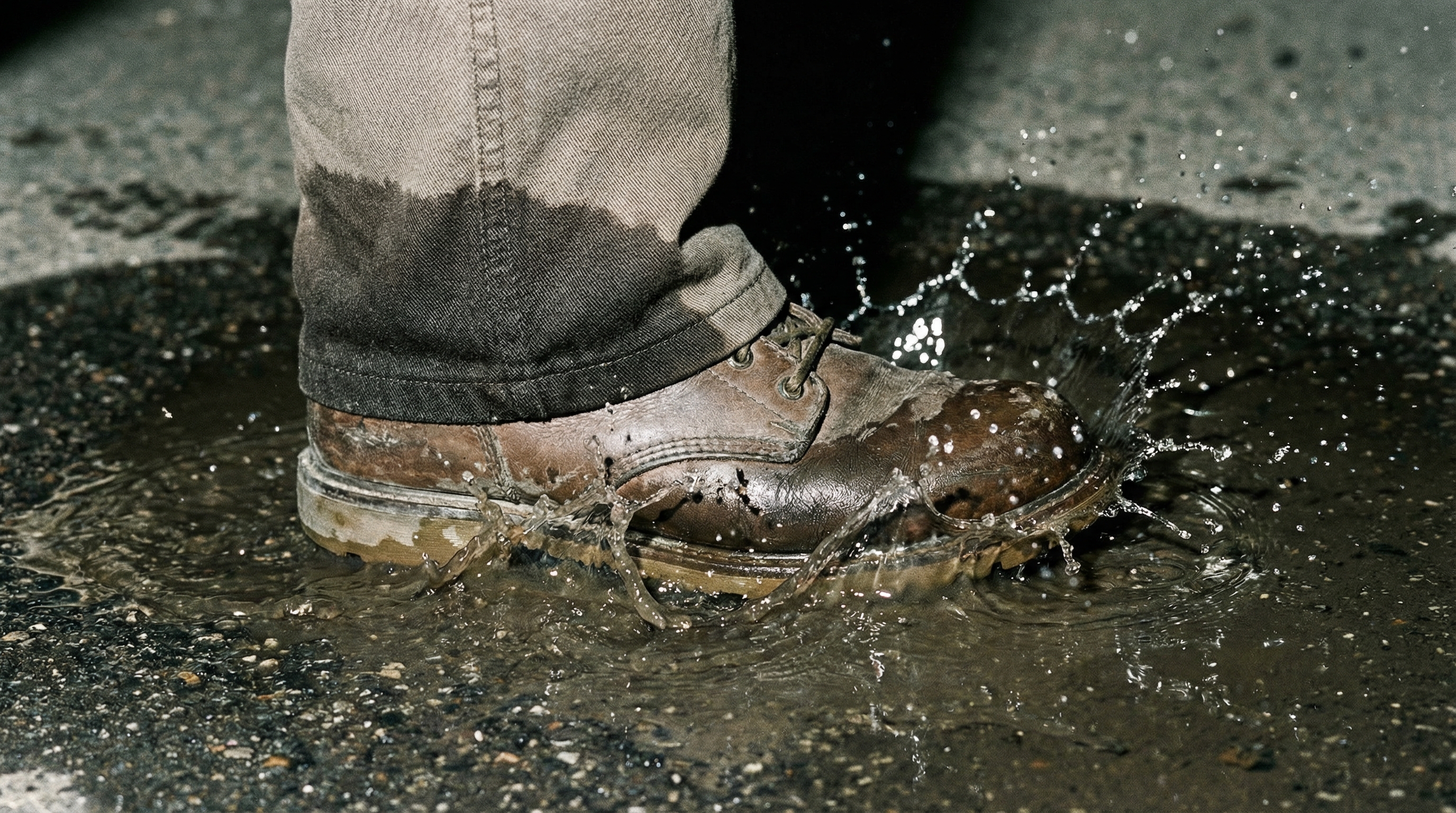
FLUID DYNAMICS_11
01.
Capillary Action & Transition
The visual system accurately simulates moisture wicking upward on the canvas pant leg. The irregular, jagged border between the dry, porous grain of the fabric and the saturated, heavy tonal weight of the wet hem demonstrates a deep understanding of physical material properties.
02.
Kinetic Fluid Dynamics
The splash is a mathematically precise freeze-frame of chaos. Suspended droplets vary in volume and velocity, each acting as a microscopic optical lens where harsh, directional light refracts to create sharp, specular highlights and distinct micro-shadows.
03.
Differential Weathering
The leather boot exhibits deep structural creasing and micro-abrasions. The Engineered Visuals calculate exactly how light behaves—becoming highly reflective over the smooth, wet leather while remaining matte and absorptive where the material is scuffed.

THERMAL SHIFT_09
The profound sense of reality in these Engineered Visuals is anchored by two critical physical details:
01
Thermal Material Degradation
The transition between the organic dermis and the internal armature exhibits advanced material logic. We see asymmetrical carbonization at the tissue's edge—irregular, volumetric curling that mimics high-intensity heat exposure—juxtaposed with the metallic "heat-tinting" (oxidation gradients of blue and purple) on the core cylinder.
02
Subsurface Light Transport
The luminescence from the wrist cavity isn't a flat overlay. It utilizes precise subsurface scattering, where light bleeds through the translucent layers of the surrounding tissue. This interaction creates a warm, internal glow that obeys the laws of organic physics, correctly calculating shadow falloff across the underside of the digits and sleeve fabric.

OPTICAL REFRACTION_02
01 / .density
Particulate Density
The realism is anchored by micro-abrasions, structural chips along the glass edge, and the exact scattering of settled dust on the front plane. This grounds the object in a physical, tangible environment rather than a sterile digital vacuum.
02 / .scattering
Volumetric Atmospheric
The incident white light and resulting chromatic dispersion interact dynamically with suspended atmospheric dust. This creates a dense, volumetric presence, allowing the viewer to perceive the exact physical volume the light occupies.
03 / .refraction
Internal Refraction
Capturing the chaotic beauty of light hitting microscopic internal fractures. The visual calculates not just the primary exit beam, but the internal structural flaws of the glass medium according to strict optical physics.

BIOLOGICAL STRESS_07
01
Volumetric Particulate Scattering
The atmosphere is defined by precise light interaction with suspended dust. The light does not merely overlay the subject; it wraps around the anatomy and adheres to physical falloff logic, creating deep environmental authenticity.
02
Micro-Surface Fidelity
Interaction of light on the workbench demonstrates advanced material logic. Specular highlights map flawlessly to the greasy, uneven texture of the metal, creating a stark contrast against the matte, grime-layered uniform.
03
Anatomical Tension
Visual weight is anchored by the compression of the hands against the surface and the visible tension in the forearm musculature. This physical logic prevents the subject from floating, locking them into the geometry of the space.
ADVANCED KINETIC AUDITS

HEMODYNAMIC COUPLING
01 .
Translational Kinetic Blur Optical Artifact
The supersonic projectile exhibits distinct translational attenuation along its trajectory axis due to exposure limits exceeded by high-velocity transit. This kinetic artifact diffuses the trailing edge particulate density, smearing metallic specular highlights into a continuous gradient. The perceived spatial elongation implies extreme environmental shear forces acting upon the localized atmospheric medium during the capture interval.
02 .
Acoustic Impedance Shockwave
Rapid displacement of ambient atmospheric volume generates a high-pressure gradient, resulting in pronounced refractive distortion at the primary epidermal interface. This localized acoustic impedance disparity subjects the organic substrate to transient structural fatigue, manifesting as a compressive topological ripple. The thermal consequence of this adiabatic compression further alters the surrounding refractive index, creating an observable localized lensing effect.
03.
Corneal Specular Irregularity
The highly convex geometry of the biological ocular surface induces severe specular irregularity, compressing incident environmental illumination into a distorted hemispherical projection. This reflective impedance maps rectilinear external light sources onto a curved topological plane, obscuring surrounding particulate density through non-uniform localized attenuation. The resulting focal variance indicates a disruption in the standard optical phase boundary caused by the ambient fluid-film interaction.
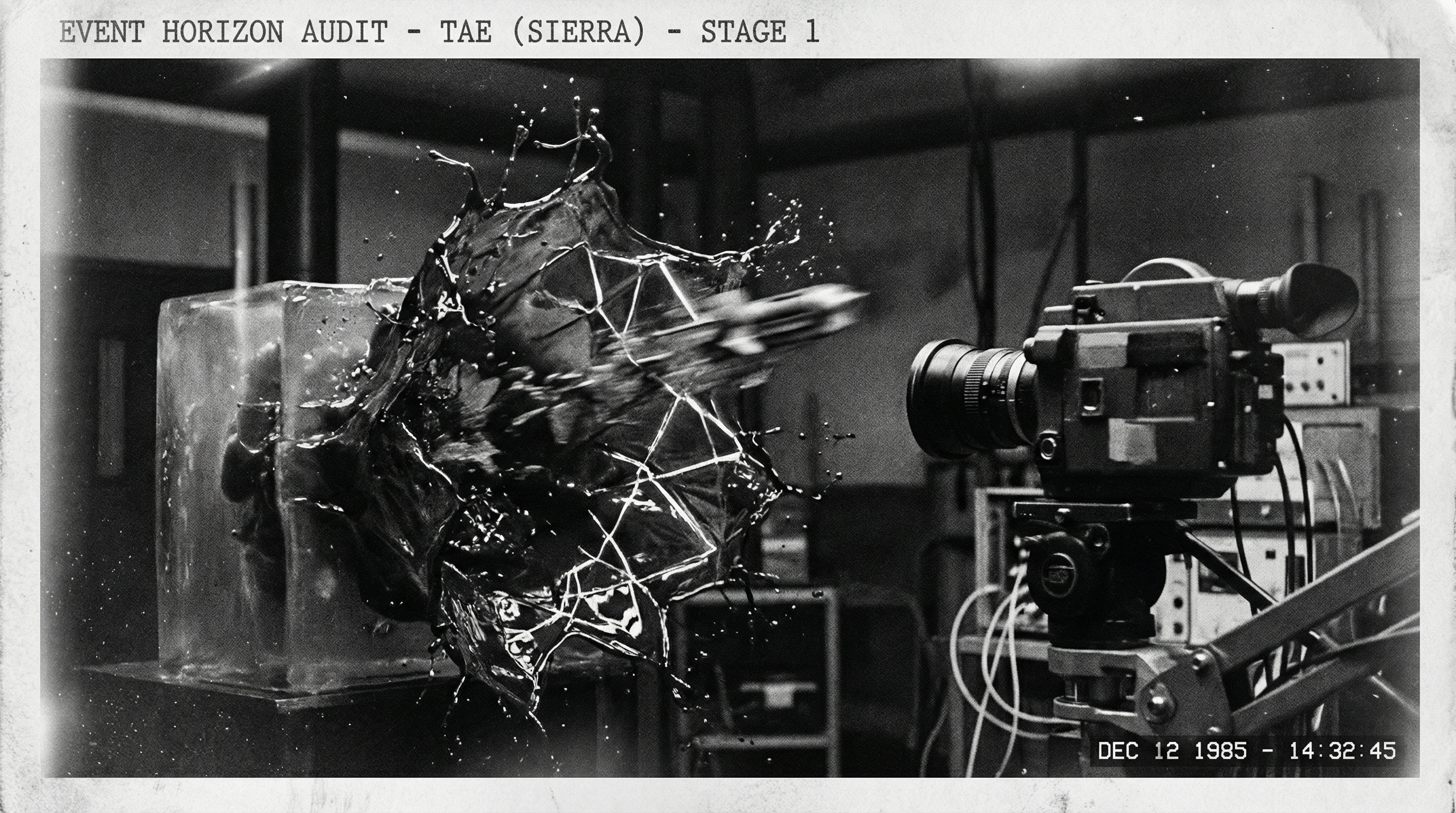
VOLUMETRIC CONSERVATION
01|
Structural Fatigue
The primary kinetic event exhibits a profound specular irregularity where high-viscosity fluid transitions into a rigid geometric lattice suggesting a localized phase transition. This phenomenon indicates internal structural fatigue that results in a calculated integrity rather than stochastic fragmentation of the medium. Internal algorithmic impedance maintains this coherence despite high-velocity kinetic energy release and localized thermal consequence.
02|
Substrate Impedance
Internal cavitation demonstrates significant volumetric attenuation as the projectile penetrates the semi-solid medium revealing a sudden shift in the refractive index profile. The visible stress patterns within the block indicate localized thermal consequence and structural fatigue where molecular bonds fail under hyper-velocity impact. The resulting optical profile suggests an impedance mismatch consistent with high-density synthetic polymers subjected to specific spectroscopic doping.
03|
Optical Impedance
The image exhibits an optical inconsistency where the shutter speed required to freeze the particulate density was insufficient to resolve high-frequency vibrations of the splashing medium. This resulting blur indicates a massive kinetic flux that exceeds the temporal resolution of the capture high-fidelity medium creating a visual smear. The grounded perspective is maintained by the predictable failure of the mechanical shutter to resolve hyper-velocity particulate dynamics.
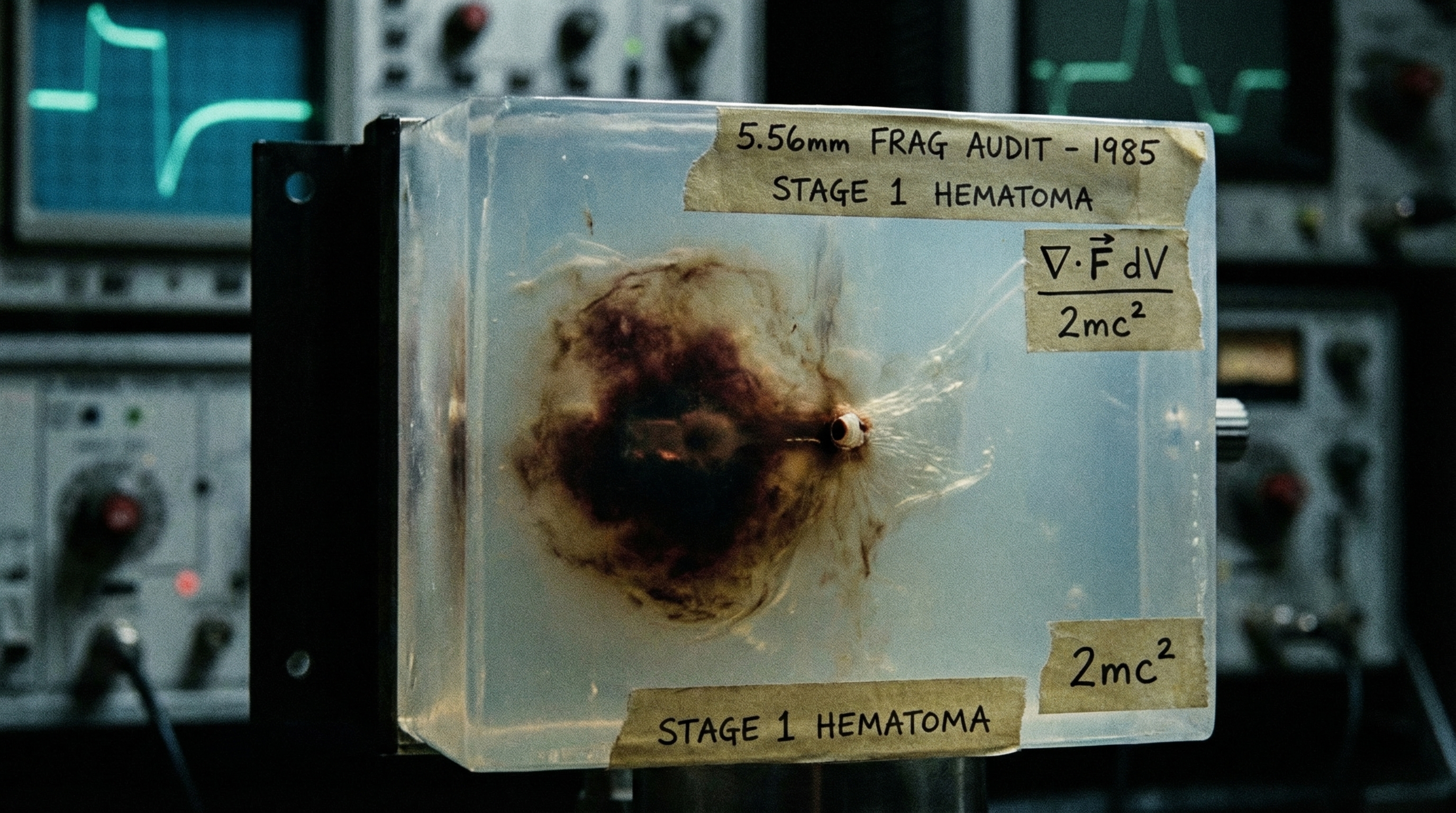
ENERGY TRANSFER LIMITS
1 / .
Viscoelastic Hysteresis Mechanical Deformation
The ballistic event induced a high-velocity kinetic transfer resulting in localized viscoelastic hysteresis within the hydrogel matrix, yielding a persistent vacuum-voided permanent cavity. This structural fatigue is characterized by the radial dissipation of energy that exceeded the polymer's elastic threshold, manifesting as non-reversible tract disruptions and secondary fracturing.
2 / .
Mie Scattering
The suspension of high-density particulate matter within the central cavitation zone facilitates significant Mie scattering, attenuating the coherent transmission of incident light. This increase in optical impedance creates a localized region of high extinction coefficients, where the concentration of organic-simulant debris disrupts the refractive continuity of the medium.
3 / .
Specular Dioptric Refraction
The interface between the ambient atmosphere and the rectangular gelatinous block induces specular dioptric refraction, distorting the spatial geometry of the background lab instrumentation. Variations in the refractive index at the block's boundaries lead to lateral chromatic aberration and focal shifts, complicating the volumetric assessment of the internal projectile trajectory.
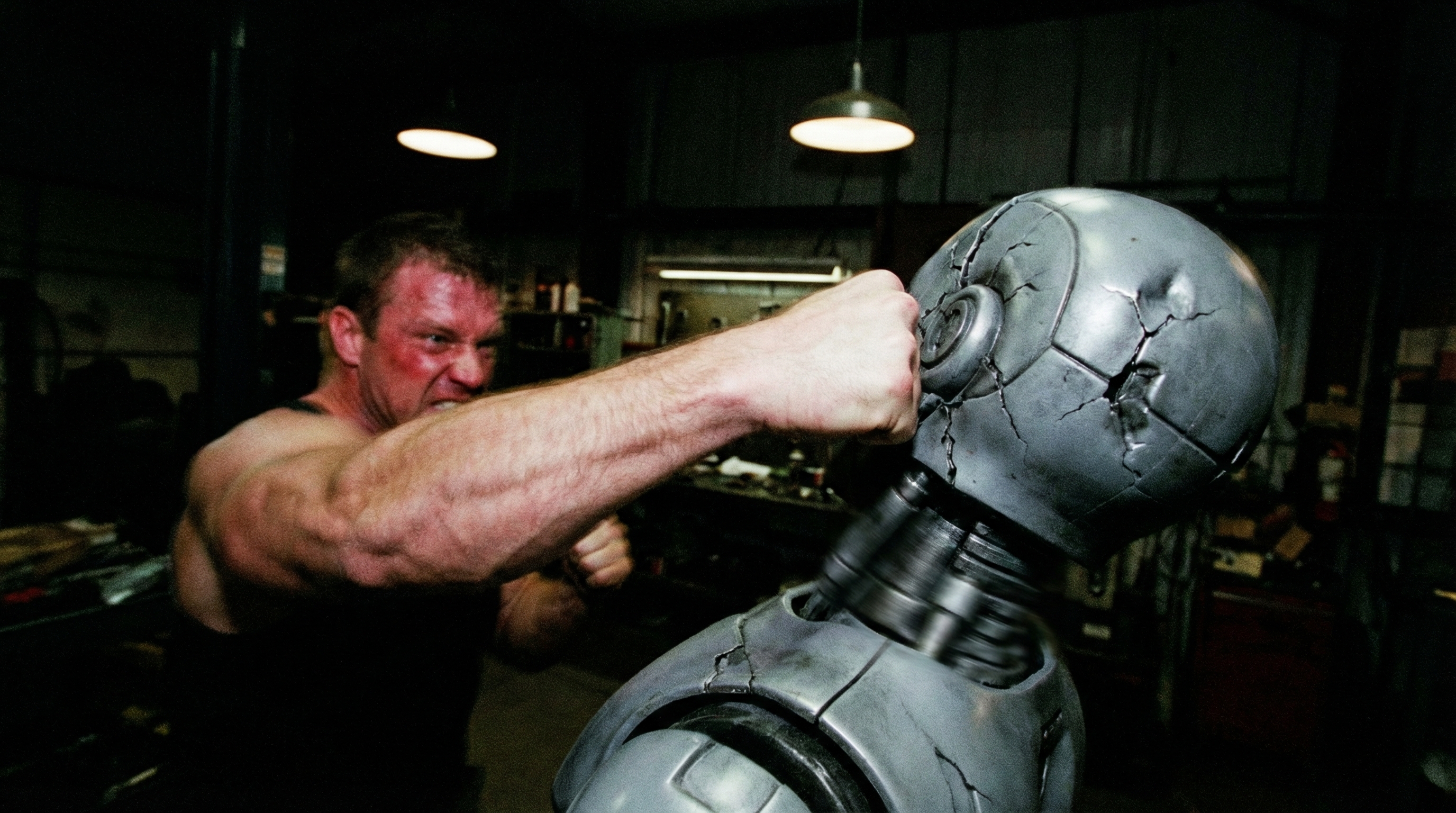
KINETIC DEFORMATION
01 / .
StructuralFatigue Kinetic Deformation
The cranium of the synthetic entity exhibits acute structural fatigue characterized by deep radial stress fractures and ductile deformation at the primary impact epicenter. This catastrophic tensile failure indicates a massive transfer of kinetic energy that exceeded the material yield strength, resulting in localized geometric collapse. The visible impedance mismatch between the striking biological mass and the metallic substrate facilitated optimal force propagation directly into the underlying structural matrix.
02 / .
TemporalDisplacement Optical Velocity Smearing
Pronounced optical smearing is localized around the cervical articulation of the synthetic unit, evidencing extreme angular acceleration resulting from the ballistic impact. This temporal displacement artifact occurs when the targeted physical velocity significantly exceeds the integration time of the capturing optical system, blurring the mechanical striations along the rotational axis. The localized kinetic blur mathematically corroborates the violent kinetic transfer and immediate spatial displacement away from the primary force vector.
03 / .
SpecularIrregularity
The metallic chassis demonstrates profound specular irregularity where the ambient overhead illumination interacts with the newly deformed topological features. High-intensity anisotropic reflections map the topography of the structural depressions, confirming an acute and chaotic alteration in the surface normal vectors. This localized photon scattering attenuates sharply along the jagged edges of the stress fractures, providing precise optical validation of the compromised material density.

BIOLOGICAL THERMODYNAMICS
01.
CrystallineDeposition
The accumulation of hoar frost on the subject's dermal and fibrous structures indicates a direct phase transition resulting from extreme ambient thermal attenuation. This increased particulate density across the surface demonstrates a significant environmental impact where moisture has undergone immediate solid-state conversion without compromising the underlying structural fatigue boundaries.
02.
SubsurfaceScattering
Photonic penetration of the snow and dermal layers creates internal scattering where light impedance is governed by the structural density of the translucent media. This specular irregularity produces a characteristic glow that reinforces the grounded appearance of the subject within the high-albedo environment while maintaining radiance consistency.
03.
DermalCyanosis
Extreme thermal consequence has initiated peripheral vasoconstriction, leading to an observable shift in the spectral absorption profile of subcutaneous hemoglobin. This attenuation of red light reflection results in a blue-shifted hue which serves as a forensic indicator of severe physiological stress caused by low-temperature exposure and subsequent metabolic deceleration.

AERODYNAMIC VELOCITY
01.
ParticulateAttenuation Fluid Dynamics
A localized breach of mechanical impedance results in a high-velocity ejecta plume characterized by fluctuating particulate density and significant light attenuation. Micro-specular highlights on spherical fluid droplets contrast with the irregular albedo of solid debris, signaling a violent disruption of the subject's structural integrity.
02.
SpecularIrregularity
Prolonged environmental exposure has induced extreme specular irregularity across the dermal surface, manifesting as a complex matrix of localized micro-shadowing and altered albedo. This physical accumulation of particulates and structural weathering prevents cohesive reflection, resulting in a matte texture that confirms the subject's material grounding.
03.
SpatialFrequencyDecay
The rapid decay of spatial frequency beyond the primary plane of focus simulates atmospheric attenuation and lens-induced focal divergence. This optical phenomenon artificially enforces three-dimensional volume by reducing the textural fidelity of distal background elements, grounding the foreground through deliberate manipulation of light scattering.
HOOK LIBRARY
AUTHORITY STRATEGY
True cinematic atmosphere isn’t a happy accident. It’s the result of rigorously designed Visual Systems. Here is how we engineer absolute reality.
CONFLICT & RESOLUTION
Flat lighting and lifeless textures destroy credibility. The solution lies in physical logic. Watch how we apply Forensic Realism to construct environments you can actually feel.
SENSORY AESTHETIC
Tangible textures. Volumetric light. Uncompromising grit. Step inside the architecture of Engineered Visuals.
"Atmosphere cannot be faked; it must be calculated. By treating light behavior, material friction, and environmental particulate as interconnected data points, we move beyond approximation. This is the architecture of Forensic Realism. Absolute precision. Deterministic output. Visual Systems built for the uncompromising. Engineered Visuals."
> FOR ENTERPRISE INQUIRIES, CLOUD PARTNERSHIPS, OR TECHNICAL AUDITS.
> DETERMINISTIC RESPONSES ONLY. NO PROBABILISTIC HALLUCINATION.